


The Jane Hotel
- Sep 1, 2023
- 10 min read
Updated: Nov 20, 2023
During the summer of 2021, in the midst of the COVID-19 pandemic, Natalie, my travel nursing daughter took a Labor and Delivery job at Harlem Hospital, which brought me to Manhattan to help her hunt for an apartment. Natalie had her sights set on living in the West Village, which I soon discovered is the place to live. Even during a global pandemic, finding an apartment in the West Village is quite the duanting task, with dozens of applicants vying for every open studio. In the meantime, Natalie needed a temporary place to stay, and that is how I randomly came across the Jane Hotel. A reasonably priced solution and quite an intriguing place.

The Jane Hotel is an eclectic boutique hotel with a storied history and a promise of an interesting future. Located on 113 Jane Street in the West Village, overlooking the Hudson River Park, the Jane offers lodging at relatively inexpensive prices with rooms that range from tiny 'cabins' with bunks to small "captain" suites.
113 Jane Street surely holds a treasure trove of stories. This single location has over a century of history and has taken on a wide variety of identities. From serving as a Relief Center for Sailors, to being a historic site of Titanic drama, this place has seen it all. It has been the site of an illegal barricade and violent riot. It has fallen into difficult times as a cheap seedy rooming house catering to the homeless and downtrodden. For a time, it was the epicenter of the NYC's punk rock scene. In addition, it has housed an acclaimed off-Broadway theater, and later transformed into a trendy boutique hotel, and home of an A-list celebrity nightclub. Most recently it was home of popular night club frequented by NYU college students and a hostile-like hotel for students and young travelers. And now, it is being be transformed yet again into an exclusive private social club.
Sailors' Home and Relief Center - 1907
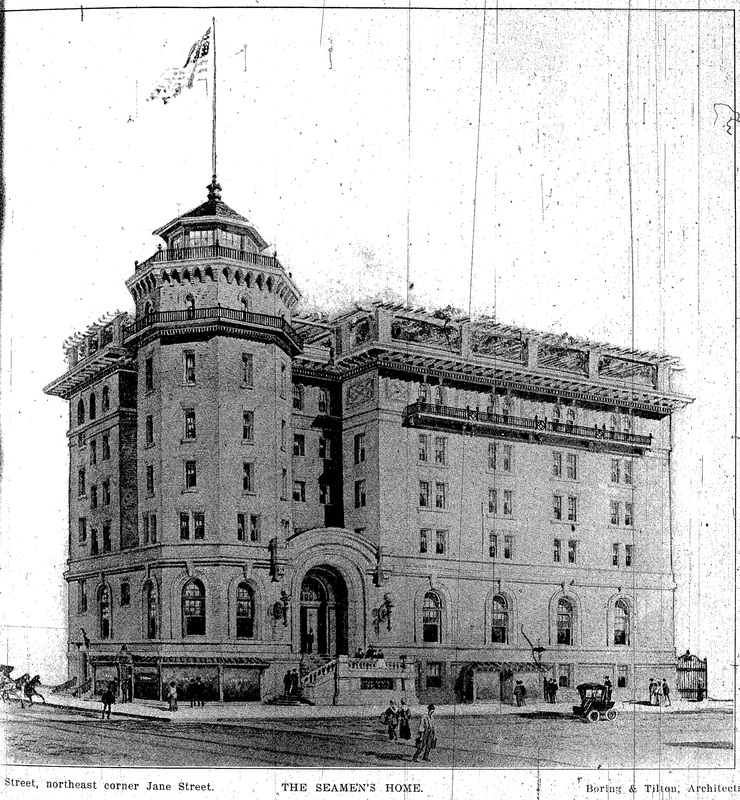
Long before it was the Jane Hotel, the building on 113 Jane Street served as New York City's safe haven for weary sailors and merchant marines, as the American Seaman's Friend Society's Sailors' Home and Relief Center.
Throughout the 19th century the American merchant marine industry thrived, fueled by an expanding and industrializing world economy. Major seaports like New York City attracted young sailors and seamen employed by big and small shipping businesses. While working, sailors spent most of their time at sea, but when in port, with hard-earned paychecks, they often enjoyed the excesses and vices of saloons, brothels, and gambling dens. All too often they would suffer from the likes of thieves and scoundrels and squalid conditions of short-term boarding houses.
During those times, evangelical and city leaders concerned about the depravity and decay of the city's seaport neighborhoods, established the American Seaman's Friends Society or ASFS. The society's stated goals were "to improve the social, moral and religious condition of seamen; to protect them from fraud; and from becoming a curse to each other and the world; to rescue them from sin and its consequences, and to save their souls.... by providing safe boarding, savings banks, register offices, libraries; and also, the ministrations of the gospel, and other religious blessings."
By the turn of the 20th century, the Seaman's Society was in dire need of boarding space along the Hudson River waterfront. Fortunately, the Society recieved an unsolicited gift of $150,000 from Olivia Sage, widow of financier Russell Sage and one of the world's wealthiest and most important philanthropic women of that time.
Noted Architect William A. Boring, known for designing Ellis Island’s immigration halls was hired to design the new AFSF Headquarters Home and Relief Center on Jane Street. The six-story structure was completed in 1907 with a distinctive lighthouse-like octagonal tower and beacon, shining its light brightly over the Hudson River and New York Harbor as a guidepost to returning merchant marine seamen. The new center featured nearly 200 bunk and cabin type rooms, a chapel, concert hall, a bank, and a bowling alley.
Safe Haven for Survivors of the Titanic
In the spring of 1912, the Sailor's Home and Relief Center aka 'the Jane' became part of shipping history. As midnight approached on the night April 15th in the icy North Atlantic, the largest ocean liner in service at the time, the RMS Titanic struck an iceberg. Her sinking just two hours and forty minutes later resulted in the deaths of more than 1,500 people, one of the deadliest peacetime maritime disasters in history. The Titanic was just four days into her maiden voyage from Southampton to New York City.
On the night of the disaster, the ocean liner RMS Carpathia having received distress signals arrived at scene an hour and a half after the Titanic went down. For the next four and a half hours, the ship took on 706 survivors from Titanic's lifeboats. It took three days for Carpathia to reach New York after leaving the scene. Alerted to the disaster by radio messages from Carpathia and other ships, the Sailor's Home and Relief Center on Jane Street rallied to prepare a place of safe harbor for Titanic's traumatized surviving crew.
Carpathia slowed by ice, fog, thunderstorms and rough seas finally arrived at 9:30 pm on 18 April at Pier 54, just a short walk away from Jane Street. Tens of thousands of onlookers were waiting along the wharves and piers to greet the rescue ship. The Titanic's 214 surviving crew members were brought through the throngs on that rainy night to the nearby Sailor's Relief Center. Once at the Jane, the crew members were given clothing, food, and a room. Many were in very bad shape, and in great distress, having survived a terrible ordeal with so many of their crew mates lost at sea. Like their fellow passenger survivors, they had lost everything and now were in New York City with nothing more than the clothes on their back.
On the very next day, 19 April, the first memorial service for the tragic sinking was held in the Jane's auditorium (now ballroom). As reported by the New York Times "with well over a hundred people in attendance, the song Nearer, My God, to Thee was sang with a mighty, roaring chorus." Also on that day, the US Senate's emergency inquiry into the Titanic disaster initiated, starting quickly in order to gather accounts from passengers and crew while events were fresh in their minds. The inquest subpoenaed all surviving British passengers and crew while they were still on American soil, which prevented them from returning to the UK before the inquiry completed. Most of the crew remained housed at Jane Street throughout the inquiry.
YMCA - The Red Riot
During the early 1930s, the Jane Street property was transferred from the American Seaman's Society to the YMCA. The YMCA continued to operate the facility as a Seamen's house. In the spring of 1933, during the Great Depression, the facility became overcrowded with sailors seeking shelter. The YMCA superintendent decided to open the large auditorium to house the overflow residents. Unfortunately, the situation deteriorated. As the crowded conditions became volatile, the unruly men were ordered to leave after they refused to clean up their temporary sleeping quarters. However, instead of leaving, they barricaded themselves in the auditorium and sang the "Communist Internationale," the well-known anthem of the international communist movement.
Twenty patrol and ten mounted policemen responded to the riot call. The fifty-seven rebellious men who had barricaded themselves in the auditorium refused to cooperate. After an extended standoff, the police stormed the barricades amid flying chairs and swinging police batons. All fifty-seven seamen were eventually arrested and taken to jail for disorderly conduct.
Communist Internationale Anthem
Arise, you prisoners of starvation,
Arise, you wretched of the earth,
For justice thunders condemnation,
A better world's in birth. No more tradition's chains shall bind us,
Arise, you slaves, no more in thrall;
The earth shall rise on new foundations,
We have been naught, we shall be all.
'Tis the final conflict, Let each stand in his place.
The international working class Shall be the human race.
The Jane West Hotel
In 1946 the YMCA removed the lighthouse beacon from the tower and sold the building to new owners who renamed it the Jane-West Hotel, signaling the end of its nautical history. The Jane-West Hotel was both a residential and transient hotel. Known as an SRO, or single room only, hotel with those living there mostly loners, drug addicts, or those recently released from detox or mental hospitals. The neighborhood surrounding the Jane West at the time was a mix of old warehouses, factories, mills, and abandoned lots and structures.
Jack Dolan's STEP Program at the Jane West.
Jack Dolan was a 22-year-old idealistic social worker from Waterbury, Connecticut, who arrived in New York City in 1937 with a newly earned master's degree from the University of Colorado. He was passionate about helping the downtrodden and found a job with the city serving the neediest poor in the gang-ridden Bowery neighborhood, New York City's skid row.
In 1947, Jack became the director of the city funded Manhattan Bowery Project, which operated a 48-bed hospital detoxification center. Dolan's project was unique concept at the time in that it offered willing men from the streets and alleys a five or six-day stay at the detoxification unit, followed by outpatient care.
To expand the mission, Dolan's innovative program rented the entire sixth floor of the Jane-West Hotel, where he created the Supportive, Therapeutic, Environmental Program (STEP) . The STEP program provided 14 cabin rooms, a large day room, and a full time live-in social worker. Residents who were released from detox came to the Jane West to stay and receive professional help in finding work, and reconnecting with their families, as a step towards rejoining healthy society.
The Jane West Hotel operated for over 40 years as a low budget hotel until it was sold and renamed the Riverview Hotel in 1988.
Home of an off-Broadway Theater
The Theater for the New City and The Jane Street Theater
In 1970 the large unused auditorium in the Jane West Hotel caught the eye the owners of the Theater for the New City (TNC) which was dedicated to emerging playwrights, presenting the work of small developmental and experimental theater companies.
In 1971 TNC moved its home to Jane West Hotel and established the 280 seat Jane Street Theater in the converted auditorium. The theater was an immediate success and played a large part in rehabilitating the neighborhood. During its time at the Jane West, the Theater for the New City cemented its reputation for being the most avant of avant-garde theaters, offering radical political plays, experimental poetic works, dance theater, musical theater and even film.
In 1977 the TNC moved to the East Village, but the Jane Street Theater remained open as an independent concert and off-Broadway theater venue until 2005. During it's run the Jane Steet Theater gained a legendary status in the rock musical world, being where the cult rock musical Hedwig and the Angry Inch, and tick tick…BOOM! (by RENT’s Jonathan Larson), both had their initial runs.


The Rock Hotel - Hardcore Punk Rock
New York: The First Punk Rock Scene
The genre known as punk rock first appeared on the scene in New York City in the mid-1970s. Bands such as the Ramones, Blondie and the Talking Heads were playing regularly in the New York's Bowery District, most notably at the legendary club CBGB.
The Early Days of Hardcore Punk Rock

Hardcore punks rose to popularity in the late '70s and early '80s, happening in multiple cities throughout the U.S. almost simultaneously. Musicians that had been raised on heavy metal but were being influenced by punk were taking these two influences, combining them, and speeding them up into something exciting and unheard of.
Faster and heavier than other contemporary punk bands, hardcore punk songs were often very short and very frenzied.
In the early 1980's , a promoter named Chris Williamson started putting on punk rock shows at the Jane Street Theater, morphing the space into what became known as the Rock Hotel. The Jane hosted a series of notable hardcore punk rock shows in the early-to-mid `80s, featuring bands like Samhain, Bad Brains, Kraut, the Cro-Mags, Murphy’s Law, Discharge, The Exploited and many more. By 1985, Williamson moved the Rock Hotel series over to the roomier Ritz Club in the East Village.


The Riverview Hotel
In 1988 the Jane West Hotel sold to new owners who renamed it the Riverview Hotel. Throughout the 1990s and early 2000s the Jane Street Theater continued to operate on the ground floor, while the Riverview Hotel operated on the upper floors providing low budget lodging to the poor and homeless. The hotel gradually devolved into essentially a shelter for drunks, drug addicts and drifters. The Jane Street Theater went out of business in 2004 and the Riverview was sold to developers in 2008.
The Jane Hotel

In 2008 developers Sean MacPherson and Eric Goode purchased the Riverview Hotel for $27 million with plans to refurbish and reopen the property as The Jane Hotel.

MacPherson and Goode, successful entrepreneurial restauranters and nightclub owners decided to break into the hotel business with the idea of opening unique hipster hotels in lower Manhattan. Beginning in 2001, they purchased a series of historic, run-down buildings and restored, refurbished, renovated them, creating one-of-a-kind boutique hotels, with bars, restaurants and nightclubs. The properties include The Maritime in the Meatpacking District/West Chelsea neighborhood, The Bowery Hotel in the Bowery, The Ludlow in the Lower East Side, The Marlton House in Greenwich Village, and The Jane Hotel in the West Village.
The Jane Hotel opened in 2009 with with nearly 200 bunk and cabin type rooms restored with a nautical look and feel harkening to the original Sailors' Home and Relief Center and the days of Titanic lore.
The front desk is staffed by men and women in bell caps and maroon uniforms. Keys and mail are still stored in the boxes behind the counter and a call bell is rung for the baggage.


The Jane Ballroom
The new Jane Hotel included a nightclub dubbed The Jane Ballroom. It was fashioned from the space left from the shuttered Jane Street Theater. To promote and operate the club, MacPherson and Good partnered with entrepreneurs Carlos Quirarte and Matt Kliegman with the vision of a night spot with a living-room-like vibe, a haunt for downtown NYC hipsters. At the time MacPherson and Good were hosting parties around downtown and had just opened a restaurant , the Smile, on Bond Street.

The ballroom's makeover was a carefully curated interior decoration job designed to look and feel as though it had been there for a century or more. At its center was a huge mirrored disco ball from MacPherson’s Los Angeles home. A grand antique fireplace was salvaged from Belgium. Vintage tiles in the entryways were from Argentina. A mirror framed with animal horns hails from Scotland and artwork from India covered the walls. The plush velvet couches, dark wood, potted palms gave the feeling you had just walked into an eccentric relative’s old mansion. In addition to the ballroom space, they opened an intimate rooftop cocktail bar with stunning Hudson River views.


The Jane Ballroom quickly caught on and before long was one of Manhattan's hottest night spots frequented by New York's A-list celebrities. Long lines outside the Jane Ballroom started early, the evenings would start with a cozy low-key, laid-back bohemian vibe, but after midnight the parties would rage, with the Jane's cutting-edge DJ's having the crowds dancing on the tables. During the 2010's the Jane Ballroom was undoubtedly one of New York City's iconic night spots. For years, the ballroom was known for its celebrity crowd. It was a destination for countless young celebrities like Lindsay Lohan, Kirsten Dunst , Mary-Kate Olsen, Jennifer Aniston, John Krasinski, Kate Winslet, Courtney Love, Tom Brady and Gisele, Snoop Dogg, and Woody Harrelson and others.


In late 2022 the Jane Hotel was purchased by Jeff Klein's JK Hotel Group for $62 Million. Klein intends to eventually close the Jane, renovate and open an East Coast version of his trendy private members-only LA clubs, the San Vincente Bungalows, the City Cub and the Monkey Bar.


Comments